
When operations stop, the decisions cannot.
Understand your critical activities, dependencies and recovery priorities before a disruption puts them to the test.
Talk to a Consultant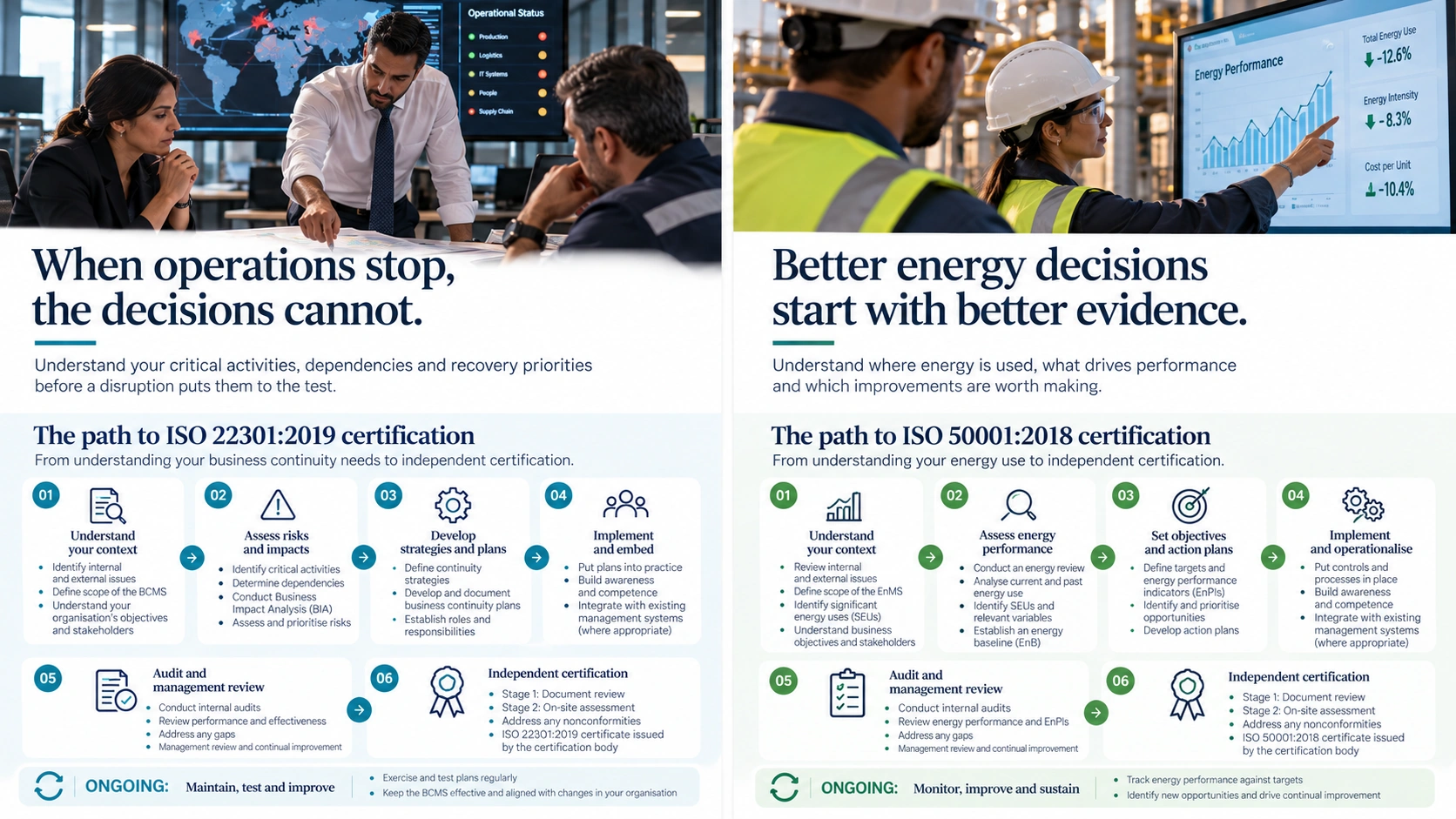
Who this helps
A critical supplier fails. A site becomes inaccessible. A system outage interrupts customer deliveries. The immediate problem may be obvious; the consequences often cross several teams before anyone has a complete picture.
ISO 22301 is relevant to businesses that need to maintain essential products and services through disruption, including engineering and industrial providers, logistics operators, multi-site service companies and organisations with contractual continuity expectations.
Published edition: ISO 22301:2019, including the applicable 2024 climate-action amendment. A revision is under development; published requirements and any transition arrangements are checked during scoping. Official ISO edition information
What the standard supports
ISO 22301 provides requirements for a Business Continuity Management System (BCMS). It helps organisations establish continuity priorities, understand the impact of interruption, select workable response and recovery arrangements, and learn through exercises and review. The purpose is not to predict every incident. It is to make critical decisions more prepared and less improvised.
Practical business value
- A clearer view of which activities and dependencies are genuinely critical.
- Defined responsibilities, recovery priorities and decision routes when disruption occurs.
- Greater confidence in continuity arrangements through exercising and lessons learned.
Areas we work through
Understand the impact.
Establish the BCMS scope and conduct a business impact analysis. Identify key services, acceptable interruption tolerances, essential resources and dependencies on people, premises, technology and suppliers.
Agree credible responses.
Assess disruption risks, evaluate continuity strategies and develop proportionate response and recovery procedures. Plans should recognise actual staffing, equipment, site and supplier constraints.
Prove the arrangements.
Support exercising, incident communication arrangements, internal audits, management review and corrective action. A plan that has never been tested may conceal assumptions the next disruption will expose.
Implementation and integration
Crosby reviews existing emergency response, IT recovery and operational arrangements before proposing new documentation. We work with process owners to connect business continuity to operational risk, contractual commitments and existing management systems. IT disaster recovery can be an important part of the solution, but business continuity extends to the wider ability to deliver products and services.
A practical question: If your most important facility became unavailable tomorrow, who would decide what continues first, and on what evidence? The answer should not depend on who happens to be in the office.
Explore HSEQ Consultancy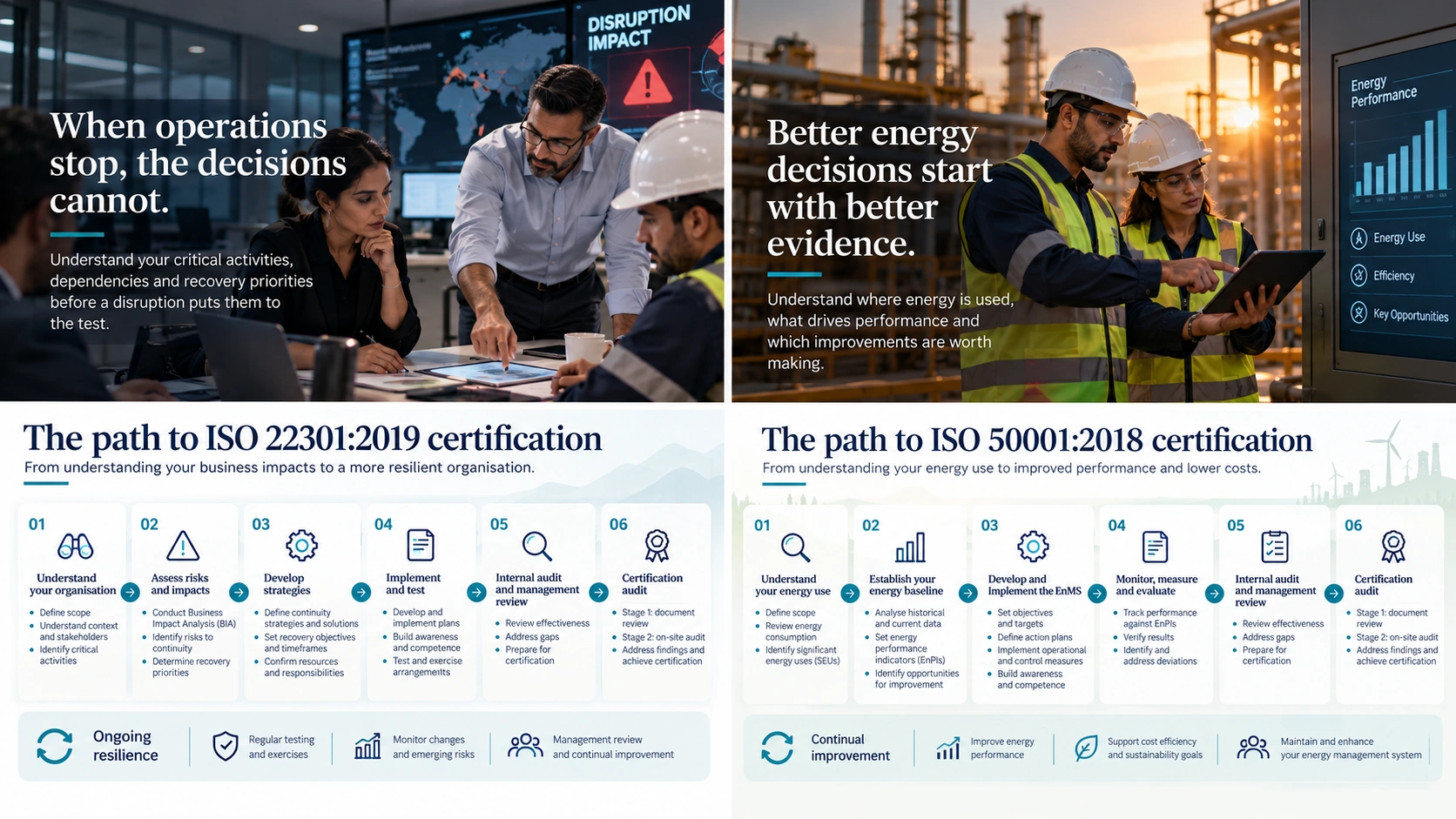
Scroll across on a small screen to read each step. Open original artwork ↗
A clear path to improvement
Discover
Understand operations, goals and stakeholders.
Assess
Review requirements, controls and priority gaps.
Design
Agree proportionate processes and an action plan.
Implement
Help your people put controls into use.
Verify
Review evidence, findings and readiness.
Improve
Close gaps and sustain progress.
Frequently asked questions
Is a Business Continuity Plan enough for ISO 22301?
A plan is only part of the system. ISO 22301 also addresses how continuity needs are understood, responsibilities assigned, arrangements exercised and performance reviewed.
Is business continuity the same as IT disaster recovery?
No. IT recovery may be critical, but continuity also covers people, premises, suppliers, equipment, communications and customer delivery.
Do we need to test every possible disruption?
No organisation can rehearse every scenario. Exercises should be proportionate and designed to challenge critical assumptions, decision-making and recovery capabilities.
Can this be integrated with an existing management system?
Yes. Governance, internal audits, management review and corrective action can be coordinated, with continuity-specific analysis and response arrangements retained.
Does Crosby issue ISO certificates?
No. Crosby provides consultancy and readiness support. Independent certification bodies conduct certification audits and make certification decisions.
Your next improvement starts here.
Practical support for stronger systems and safer operations.
